OptiCore Pro Official Website › Supplement Facts
Supplement FactsOptiCore Pro Supplement Facts: The Full Label
The OptiCore Pro panel lists sixteen nutrients, each with an amount and a % Daily Value, plus one 179.5 mg blend of eleven botanicals.
The serving size is one capsule, and each bottle holds 30. Every row is shown below.
For what each one does, see the ingredients page.
Every row as the bottle prints it, plus the four lines underneath that most readers skip.
The OptiCore Pro Supplement Facts panel, as printed
Seventeen rows, exactly as the bottle prints them, so this page can be held against the label.
| Row | Amount per serving | % Daily Value |
|---|---|---|
| Vitamin A (as Beta-carotene) | 60 mcg RAE | 6.5% |
| Vitamin C (as Ascorbic acid) | 60 mg | 66.5% |
| Vitamin D (as Cholecalciferol) | 10 mcg | 50% |
| Vitamin E (as DL-Alpha Tocopheryl Acetate) | 7 mg | 46.5% |
| Thiamin (as Thiamin mononitrate) | 3 mg | 250% |
| Vitamin B6 (as Pyridoxine HCl) | 4 mg | 235.5% |
| Folate (440 mcg Folic Acid) | 748 mcg DFE | 187% |
| Vitamin B12 (as Cyanocobalamin) | 6 mcg | 250% |
| Biotin | 2,500 mcg | 8,333.5% |
| Pantothenic Acid (as D-Calcium Pantothenate) | 15 mg | 300% |
| Calcium (as Calcium carbonate) | 40 mg | 3% |
| Iron (as Ferrous fumarate) | 7.25 mg | 40.5% |
| Magnesium (as Magnesium Oxide) | 60 mg | 14.5% |
| Zinc (as Zinc Oxide) | 3.62 mg | 33% |
| Manganese (as Manganese amino acid chelate) | 2 mg | 87% |
| Potassium (as Potassium Gluconate) | 47 mg | 1% |
| Proprietary Blend | 179.5 mg | † |
Serving size: one capsule. Servings per container: 30. The dagger on the last row is the label's own mark for a row with no established Daily Value.
Sixteen rows carry an amount and a percentage. The seventeenth is the proprietary blend, which carries a total of 179.5 mg and a dagger where the percentage would be, because a blend of eleven botanicals has no single Daily Value to be measured against.
Percentages above a hundred are ordinary in a multivitamin and are not a warning. A Daily Value is the amount considered sufficient for most adults, so 250 per cent of thiamin means two and a half times a sufficient amount of a water-soluble vitamin the body clears readily. Biotin at 8,333.5 per cent is the row where that reasoning starts to strain, and it gets its own section below.
Reading the OptiCore Pro label artwork
Where each part of the label sits, and the four lines under the ruled box.
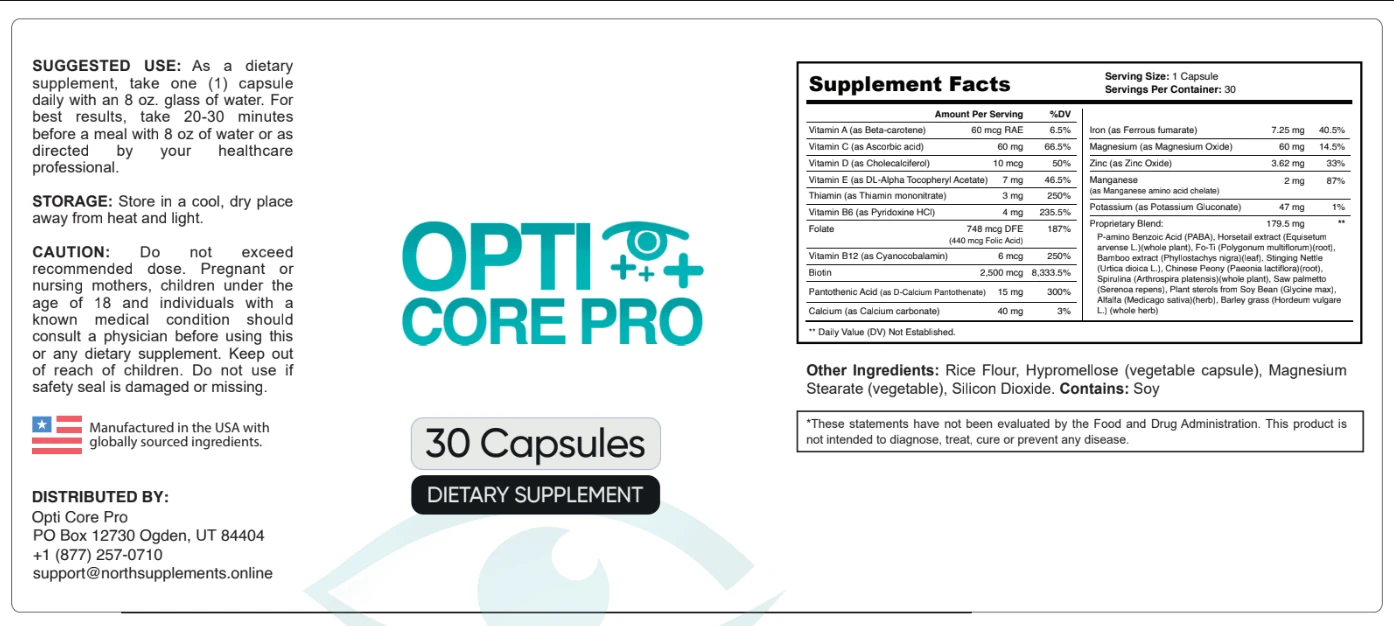
The panel occupies the right-hand side of the bottle and runs in two columns. The left column takes the vitamins from A down to pantothenic acid; the right column picks up the minerals from calcium to potassium, then the blend.
Underneath the ruled box sit four lines that are easy to skim past and worth reading: the other-ingredients line, the allergen statement, the suggested use and the caution. All four are reproduced on this page.
One detail is worth checking on the bottle in your own hand rather than on a screen. The lot code and the best-before date are stamped on the base, not printed with the panel, and the batch page explains what that code does and does not establish.
The OptiCore Pro proprietary blend line
Eleven names, one number, and what that format allows a reader to conclude.
- P-amino Benzoic Acid (PABA)
- Horsetail extract – Equisetum arvense L., whole plant
- Fo-Ti – Polygonum multiflorum, root
- Bamboo extract – Phyllostachys nigra, leaf
- Stinging Nettle – Urtica dioica L.
- Chinese Peony – Paeonia lactiflora, root
- Spirulina – Arthrospira platensis, whole plant
- Saw palmetto – Serenoa repens
- Plant sterols from Soy Bean – Glycine max
- Alfalfa – Medicago sativa, herb
- Barley grass – Hordeum vulgare L., whole herb
Eleven botanicals in printed order, sharing one total of 179.5 mg. That is how a proprietary blend is written, and it is permitted: a manufacturer must name every ingredient and must give the blend's total weight, but need not divide the total between the members.
The consequence for a reader is arithmetic rather than mystery. Every name is visible, so nothing is hidden, but no member can be set against the amount its own research used, because that comparison needs two figures and the label supplies one.
For scale: split evenly, 179.5 mg across eleven is about 16 mg each. The horsetail trial used 900 mg a day of dried extract on its own. The plant sterol work runs at 2 to 3 grams a day. Even the most generous possible split leaves every member well below the amounts its literature is built on.
The OptiCore Pro other ingredients, allergen and capsule shell
Eight printed lines from under the ruled box, quoted rather than paraphrased.
| Printed line | What the bottle says |
|---|---|
| Other ingredients | Rice Flour, Hypromellose (vegetable capsule), Magnesium Stearate (vegetable), Silicon Dioxide |
| Allergen statement | Contains: Soy |
| Capsule shell | Hypromellose, a plant cellulose. Suitable for a vegetarian diet. |
| Suggested use | As a dietary supplement, take one (1) capsule daily with an 8 oz. glass of water. For best results, take 20-30 minutes before a meal with 8 oz of water or as directed by your healthcare professional. |
| Caution | Do not exceed recommended dose. Pregnant or nursing mothers, children under the age of 18 and individuals with a known medical condition should consult a physician before using this or any dietary supplement. Keep out of reach of children. Do not use if safety seal is damaged or missing. |
| Storage | Store in a cool, dry place away from heat and light. |
| Origin | Manufactured in the USA with globally sourced ingredients. |
| Distributed by | Opti Core Pro, PO Box 12730, Ogden, UT 84404 |
Every line above is quoted from the bottle rather than summarised.
Four inactive ingredients, and none of them carries a dose. Rice flour fills the rest of the capsule, hypromellose is the shell itself, magnesium stearate stops powder sticking to the tooling, and silicon dioxide keeps it flowing. A capsule needs all four or something like them.
The allergen line is the one that rules people out rather than asking them to weigh something. Soy is declared because the blend contains plant sterols derived from soy bean, and anyone avoiding it should treat this product as unsuitable without further reading.
What the OptiCore Pro percentages mean, including 8,333.5%
What the column actually measures, and why one row in it is worth stopping on.
A per cent Daily Value compares the amount in one serving with a reference figure set for adults. It is a labelling convention rather than a dose recommendation, and it answers one question: how does this compare with what a typical adult needs in a day.
Water-soluble vitamins are where large percentages are commonplace. Thiamin at 250 per cent, pantothenic acid at 300 per cent and B12 at 250 per cent are all ordinary multivitamin amounts, and all three clear through the kidneys rather than accumulating.
Biotin at 8,333.5 per cent is a different order of figure. The Institute of Medicine set an Adequate Intake of 30 micrograms a day for adults and no upper intake level, specifically because straightforward toxicity has never been demonstrated. That is not the reason the number matters.
The reason it matters is laboratory. Biotin at supplement amounts interferes with a large family of immunoassays that use a biotin and streptavidin binding step, which includes some troponin, thyroid and PSA tests. A review of the mechanism sets out how it works, and the side effects page gives it the room it deserves.
Honest label analysis: the OptiCore Pro graphic against the printed panel
Where the marketing art and the regulated panel differ, and which one this site follows.
The seller ships a graphic headed INSIDE OPTICORE PRO which features six nutrients: Vitamin A (Beta-carotene), Vitamin C (Ascorbic Acid), Vitamin D, Vitamin E (DL-Alpha Tocopheryl Acetate), Thiamin (Mononitrate) and Vitamin B6 (Pyridoxine HCl). The printed panel carries seventeen rows.
Both things can be true without anyone being dishonest. A marketing graphic picks six recognisable names for a sales page; a Supplement Facts panel is a regulated format that has to carry everything. The point of saying so here is simply that the graphic is a selection rather than a summary, and a reader who treats it as the formula will be missing ten quantified rows and a 179.5 mg blend.
On this website that graphic is used as a scene image rather than as an ingredient source, and every ingredient statement is read out of the panel above. Where the seller's page and the bottle disagree about anything, the bottle is what arrives in the box and the bottle governs.
The same rule settled two other questions on this site. The seller's page names no ingredients at all, and the panel names every one, so the panel is the ingredient list. And the guarantee is 60 days rather than the longer figure that circulates in some places, because 60 is what the seller prints on its pack cards, in its terms and in its refund policy. The guarantee page sets out the terms in full.
OptiCore Pro label questions
How many ingredients does OptiCore Pro have?
Seventeen printed rows: sixteen nutrients with an individual amount, plus one proprietary blend of 179.5 mg containing eleven named botanicals. Counting every named substance gives twenty-seven, plus four other ingredients and the capsule shell.
What is the serving size for OptiCore Pro?
One capsule, and there are 30 servings in a bottle. Every amount on the panel is per capsule, which makes a bottle exactly one month.
Why does the OptiCore Pro blend have no individual amounts?
Because it is declared as a proprietary blend, a format that requires every ingredient to be named and the total weight to be given, but not the split between members. It is legal and common. What it means for a reader is that no member can be compared with the amount its own research used.
Does OptiCore Pro contain gelatin?
No. The shell is hypromellose, a plant cellulose, so the capsule suits a vegetarian diet. The only line to check against a diet is the declared soy.
What does the dagger on the OptiCore Pro panel mean?
It marks a row with no established Daily Value. On this label it sits beside the proprietary blend, because a blend of eleven botanicals has no reference figure to be measured against.
Is 8,333.5% of biotin dangerous in OptiCore Pro?
Plain toxicity is not the concern, which is why no upper intake level exists for biotin. The consequence is laboratory: at this amount it can distort immunoassays that use a biotin and streptavidin step. Tell the laboratory what you take before blood is drawn.
Where is OptiCore Pro made?
The bottle prints “Manufactured in the USA with globally sourced ingredients.” and names Opti Core Pro, PO Box 12730, Ogden, UT 84404 as the distributor. The testing and quality page reads the four seals on the pack one at a time and says what each one certifies.
Sources for reading the OptiCore Pro panel
Reference intakes for the rows where a percentage needs context, and the assay literature behind the biotin note.
- Institute of Medicine (US) Standing Committee on the Scientific Evaluation of Dietary Reference Intakes. Biotin. In: Dietary Reference Intakes for Thiamin, Riboflavin, Niacin, Vitamin B6, Folate, Vitamin B12, Pantothenic Acid, Biotin, and Choline. Washington (DC): National Academies Press; 1998. NCBI Bookshelf NBK114297. https://www.ncbi.nlm.nih.gov/books/NBK114297/
- Dasgupta A. Immunoassay design and biotin interference. Adv Clin Chem. 2022;109:165-183. PMID 35953126. https://pubmed.ncbi.nlm.nih.gov/35953126/
- Carneiro DM, Freire RC, Honorio TC, et al. Randomized, Double-Blind Clinical Trial to Assess the Acute Diuretic Effect of Equisetum arvense (Field Horsetail) in Healthy Volunteers. Evid Based Complement Alternat Med. 2014;2014:760683. PMID 24723963. https://pubmed.ncbi.nlm.nih.gov/24723963/
- Ras RT, Geleijnse JM, Trautwein EA. LDL-cholesterol-lowering effect of plant sterols and stanols across different dose ranges: a meta-analysis of randomised controlled studies. Br J Nutr. 2014;112(2):214-9. PMID 24780090. https://pubmed.ncbi.nlm.nih.gov/24780090/
- Institute of Medicine (US) Panel on Micronutrients. Zinc. In: Dietary Reference Intakes for Vitamin A, Vitamin K, Arsenic, Boron, Chromium, Copper, Iodine, Iron, Manganese, Molybdenum, Nickel, Silicon, Vanadium, and Zinc. Washington (DC): National Academies Press; 2001. NCBI Bookshelf NBK222317. https://www.ncbi.nlm.nih.gov/books/NBK222317/
- Institute of Medicine (US) Panel on Micronutrients. Iron. In: Dietary Reference Intakes for Vitamin A, Vitamin K, Arsenic, Boron, Chromium, Copper, Iodine, Iron, Manganese, Molybdenum, Nickel, Silicon, Vanadium, and Zinc. Washington (DC): National Academies Press; 2001. NCBI Bookshelf NBK222309. https://www.ncbi.nlm.nih.gov/books/NBK222309/
- Institute of Medicine (US) Standing Committee on the Scientific Evaluation of Dietary Reference Intakes. Folate. In: Dietary Reference Intakes for Thiamin, Riboflavin, Niacin, Vitamin B6, Folate, Vitamin B12, Pantothenic Acid, Biotin, and Choline. Washington (DC): National Academies Press; 1998. NCBI Bookshelf NBK114318. https://www.ncbi.nlm.nih.gov/books/NBK114318/
- Institute of Medicine (US) Panel on Micronutrients. Vitamin A. In: Dietary Reference Intakes for Vitamin A, Vitamin K, Arsenic, Boron, Chromium, Copper, Iodine, Iron, Manganese, Molybdenum, Nickel, Silicon, Vanadium, and Zinc. Washington (DC): National Academies Press; 2001. NCBI Bookshelf NBK222318. https://www.ncbi.nlm.nih.gov/books/NBK222318/
- Institute of Medicine (US) Panel on Micronutrients. Manganese. In: Dietary Reference Intakes for Vitamin A, Vitamin K, Arsenic, Boron, Chromium, Copper, Iodine, Iron, Manganese, Molybdenum, Nickel, Silicon, Vanadium, and Zinc. Washington (DC): National Academies Press; 2001. NCBI Bookshelf NBK222332. https://www.ncbi.nlm.nih.gov/books/NBK222332/
Order OptiCore Pro with the panel already read
Seventeen printed rows, 30 capsules a bottle, from $49 a bottle and 60 days from the shipping date to change your mind.
Two bottles $158 · six bottles $294 · 60-day money-back guarantee
Order OptiCore Pro On The Official WebsiteOne capsule a day · 30 per bottle · lot OPT-26/OP-2761