OptiCore Pro Official Website › Ingredients
IngredientsOptiCore Pro Ingredients: Every Nutrient on the Label
OptiCore Pro lists sixteen nutrients with an amount for each, plus one 179.5 mg blend of eleven botanicals.
Vitamin C, vitamin E, zinc and beta-carotene are the four with an eye research history. Biotin at 2,500 mcg is the largest figure on the bottle.
See every row as printed on the supplement facts panel.
Every name on the panel, every printed amount, and what each one's own research used.
Where the OptiCore Pro ingredient list comes from
One panel, sixteen amounts, one blend, and the reason this page can be specific.
The bottle is the list. Turn it around and the right-hand side carries a full Supplement Facts panel: sixteen nutrients with a milligram or microgram figure and a per cent Daily Value beside each, then one proprietary blend of 179.5 mg holding eleven named botanicals in printed order.
That makes this capsule unusually checkable for its category, and it is why the four rows with an eye-trial history can be set beside the amounts those trials used as arithmetic rather than opinion. The seller's own sales page describes the product without naming a single ingredient, so where the two sources differ the printed panel governs. The supplement facts page reproduces it row for row.
The four OptiCore Pro nutrients with an eye-trial history
Four printed amounts, and the four published trial amounts they are usually confused with.
Vitamin C
as ascorbic acid60 mg · 66.5% DV · trials used 500 mgThe row where this panel sits closest to ordinary nutritional adequacy. Sixty milligrams covers two thirds of an adult Daily Value, which is sensible for a multivitamin and a long way from a trial protocol: AREDS gave 500 mg a day for six years and every arm of AREDS2 carried the same figure forward.
Vitamin E
as DL-alpha tocopheryl acetate7 mg · 46.5% DV · trials used 400 IUThe fat-soluble half of the antioxidant pair, supplied in the synthetic acetate form that survives a capsule shell well. Seven milligrams is a little under half a Daily Value. The eye literature ran at 400 IU a day, roughly 268 mg of the same synthetic compound, in AREDS and again in AREDS2. The Physicians' Health Study II tested 400 IU on alternate days against cataract in 11,545 men and found nothing at that amount either, which is worth knowing before anyone treats the trial figure as a target.
Zinc
as zinc oxide3.62 mg · 33% DV · trials used 80 mgA trace mineral with a real role in the retina and in hundreds of enzymes elsewhere. A third of a Daily Value is a comfortable top-up for an ordinary diet. AREDS used 80 mg of zinc oxide, high enough that it added copper alongside, and the AREDS2 secondary analysis tested a 25 mg arm. The adult upper intake is 40 mg, so this row sits far inside it.
Vitamin A
as beta-carotene60 mcg RAE · 6.5% DV · trials used 15 mgSupplied as the plant precursor rather than retinol, so the body converts what it needs and leaves the rest. Sixty micrograms RAE is a different order of magnitude from the 15 mg AREDS gave, and that matters in one direction only: CARET and ATBC counted more lung cancers among smokers at 20 to 30 mg a day, and AREDS2 dropped beta-carotene for that reason. This row is nowhere near those amounts.
These four are why this capsule and the eye literature can be discussed in one sentence. Each carries a printed amount and each has a randomised trial behind it, so the comparison is precise rather than gestured at.
Read as a daily multivitamin all four are sensible, covering a meaningful slice of an adult Daily Value well inside every established limit. Read as an eye protocol they are four to twelve per cent of what the trials gave, which the dosage analysis takes row by row.
The OptiCore Pro B vitamins, row by row
Six rows, three of them the trio one randomised eye trial actually tested.
Biotin
vitamin B72,500 mcg · 8,333.5% DVThe largest single figure anywhere on this bottle, and the row that changes what the formula is. Biotin has no trial with a vision endpoint at any amount; its own human literature is hair and nails, and the review that gathered it found the evidence thin even there. The Institute of Medicine set an Adequate Intake of 30 mcg a day and no upper limit, because plain toxicity has never been the concern. The practical consequence is a laboratory one and the side effects page gives it a section.
Vitamin B6
as pyridoxine HCl4 mg · 235.5% DV · WAFACS used 50 mgOne of the three B vitamins that lower homocysteine, which is the honest basis for putting it in an eye capsule. WAFACS, the one randomised trial with an eye endpoint behind that idea, gave 50 mg of the same compound, about twelve times this row.
Folate
as folic acid748 mcg DFE · 187% DV · WAFACS used 2.5 mgPrinted as 748 micrograms of dietary folate equivalents, which is how 440 micrograms of folic acid converts. WAFACS gave 2.5 mg a day, roughly six times this. The adult upper limit for supplemental folic acid is 1,000 mcg, so this row leaves room, though not a great deal once fortified bread and cereal are counted.
Vitamin B12
as cyanocobalamin6 mcg · 250% DV · WAFACS used 1 mgTwo and a half Daily Values of the cheapest and most stable form, against the 1 mg a day WAFACS used. A review of high folic acid intake explains why the pair belong together: folate can correct the blood picture of B12 deficiency while the nerve problem continues.
Thiamin
as thiamin mononitrate3 mg · 250% DVVitamin B1, at two and a half Daily Values, water-soluble and with no eye trial of its own. A competent multivitamin carries it, which is the most accurate way to describe this half of the panel.
Pantothenic acid
as D-calcium pantothenate15 mg · 300% DVVitamin B5, the coenzyme A precursor, at three Daily Values. A multivitamin row rather than an eye one, at an ordinary supplement amount rather than a research one.
Six of the sixteen quantified rows are B vitamins, and three of them, folate, B6 and B12, are the exact trio WAFACS randomised, which makes this the closest thing on the label to a near miss rather than a coincidence. Biotin is the odd one: nothing else here is printed at eighty-three times a Daily Value, no eye argument explains it, and what it does explain is the botanical blend underneath.
Minerals and vitamin D on the OptiCore Pro panel
Seven rows, two salts worth understanding, and one number worth adding up.
| Row | Amount | % Daily Value | What it is doing here |
|---|---|---|---|
| Vitamin D (cholecalciferol) | 10 mcg | 50% | Half a Daily Value of the form the body makes in sunlight. A standard multivitamin inclusion. |
| Calcium (carbonate) | 40 mg | 3% | Three per cent of a Daily Value. At this size it is a capsule-filling mineral rather than a calcium supplement. |
| Iron (ferrous fumarate) | 7.25 mg | 40.5% | The row most worth counting against everything else you take. Two fifths of a Daily Value in one small capsule. |
| Magnesium (oxide) | 60 mg | 14.5% | The oxide salt, which is the least absorbable of the common forms and the cheapest to fit into a capsule. |
| Zinc (oxide) | 3.62 mg | 33% | A third of a Daily Value. Covered in full among the eye four above. |
| Manganese (amino acid chelate) | 2 mg | 87% | Close to a full Daily Value of a trace element most diets already supply. |
| Potassium (gluconate) | 47 mg | 1% | One per cent of a Daily Value. A token amount by design, because capsules cannot carry meaningful potassium. |
Read from the printed panel. The percentages are the label's own, calculated against the adult Daily Values.
Two rows repay a second look. A head-to-head comparison of magnesium salts found the oxide the poorest absorbed of those tested, so 60 mg of it delivers less than 60 mg of a citrate would. That is a property of the salt rather than a criticism of the figure beside it.
Iron is the one to keep in mind. The adult upper intake level is 45 mg a day from every source combined, so one capsule is a sixth of it, and anyone already taking an iron tablet should add the two together. Chronic excess reaches the liver, the heart and the pancreas without announcing itself, which is why manganese at 87 per cent is a lesser concern than iron at 40.5: the manganese limit is 11 mg a day and this row is 2 mg.
What is inside the OptiCore Pro proprietary blend?
Eleven names, one shared total, and what each one's own literature actually covers.
| Botanical, in printed order | What it is, and where its human evidence sits |
|---|---|
| P-amino benzoic acid (PABA) | A compound once sold for skin and hair. Prescription-strength potassium para-aminobenzoate has a published case of hepatitis behind it, at grams a day. |
| Horsetail extract | Equisetum arvense, whole plant. The two randomised trials that exist gave 900 mg a day of dried extract, which is five times the whole blend. |
| Fo-Ti | Polygonum multiflorum root. The compounds behind its liver signal are documented and the reports cluster at gram amounts over months. |
| Bamboo extract | Phyllostachys nigra leaf, the usual silica source here. No human trial of a bamboo-leaf supplement came back from a PubMed search. |
| Stinging nettle | Urtica dioica. The review that collects its human work covers the root; the aerial parts are a separate preparation. |
| Chinese peony | Paeonia lactiflora root. Its review literature is pharmacological rather than clinical. |
| Spirulina | Arthrospira platensis. Quality varies by supplier, and a survey of retail products found contamination in a proportion of samples. |
| Saw palmetto | Serenoa repens. Cochrane's 2023 update reports little to no benefit for the urinary symptoms it is usually sold for. |
| Plant sterols from soy bean | Glycine max, and the declared allergen. The cholesterol work runs at 2 to 3 grams a day. |
| Alfalfa | Medicago sativa herb. L-canavanine is the reason alfalfa carries a caution for anyone with lupus. |
| Barley grass | Hordeum vulgare, young herb. Its review literature is compositional rather than clinical. |
All eleven share one total of 179.5 mg. The label prints no figure for any individual botanical, which is how a proprietary blend is allowed to be written.
Eleven botanicals and 179.5 mg between them, which is about 16 mg each if the total were split evenly. Nothing in the list has a human trial anywhere near 16 mg: the horsetail work ran at 900 mg a day of dried extract on its own, and the plant sterol work runs in grams.
Read as a group the eleven are recognisable. PABA, horsetail, bamboo leaf, Fo-Ti, nettle, saw palmetto and alfalfa are the standard contents of a hair, skin and nail capsule, and 2,500 mcg of biotin sits directly above them on the same panel. That is a coherent formula for something other than eyes, and it is a part of the bottle nothing can be compared against, because comparison needs two numbers and a blend supplies one.
Honest label analysis: what OptiCore Pro leaves to other formulas
The four ingredients a reader coming from AREDS2 will look for, and which absences are defensible.
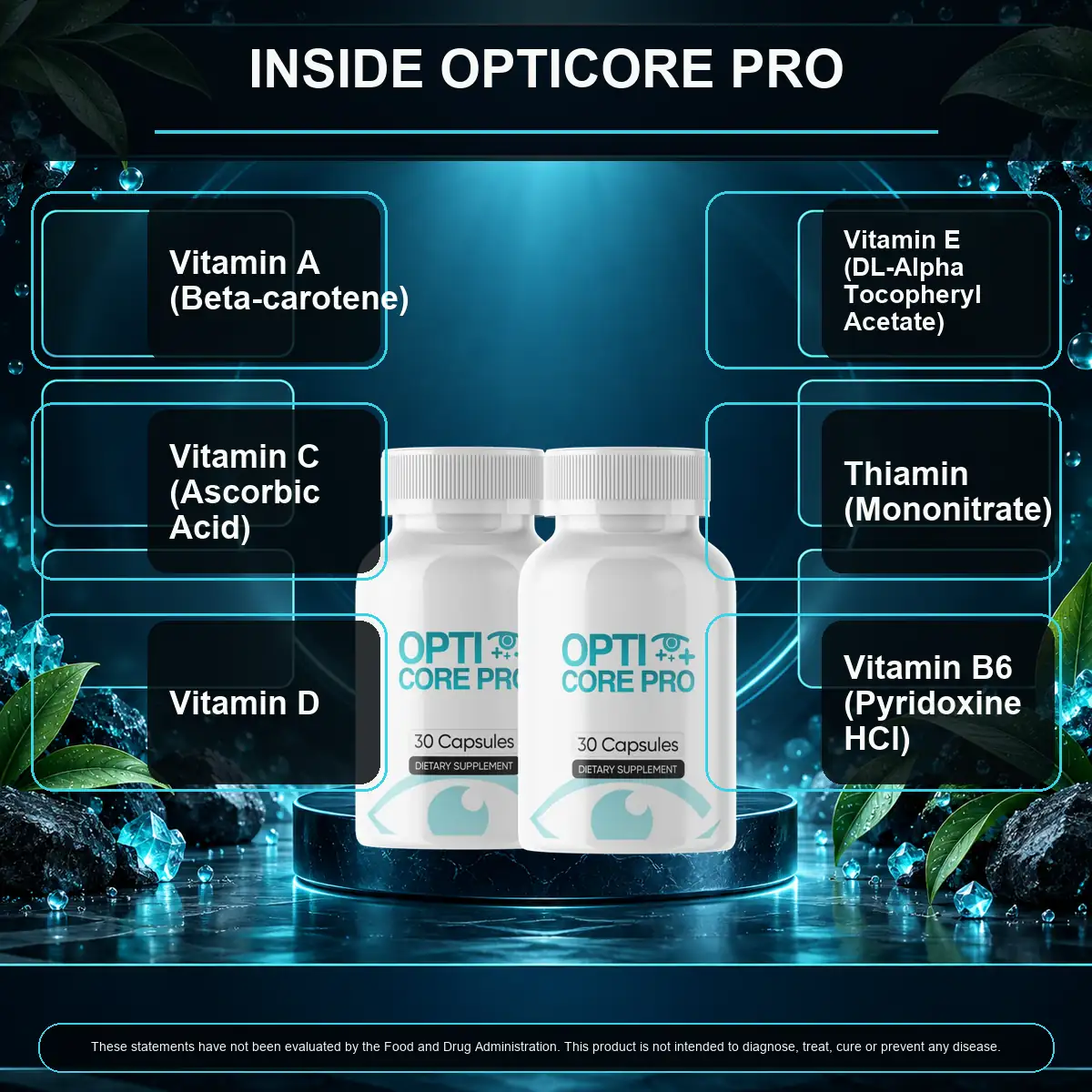
Modern eye supplements are built on two carotenoids, lutein and zeaxanthin, because they are the pigments that concentrate in the macula and because AREDS2 added them at 10 mg and 2 mg a day. Neither is on this panel. Nor is the 2 mg of copper AREDS carried specifically to offset its high-dose zinc, and nor are the omega-3 fatty acids AREDS2 tested at 350 mg DHA plus 650 mg EPA.
Two of those four absences are consistent rather than awkward. Copper is in AREDS because 80 mg of zinc depresses copper status over time; at 3.62 mg there is nothing to offset, so leaving it out is the correct decision rather than an oversight. The omega-3 arm of AREDS2 found no benefit, and the DREAM trial found none for dry eye at 3,000 mg a day either.
The carotenoids are the real gap, stated plainly once: a formula sold for screen-related comfort without lutein or zeaxanthin lacks the two ingredients with the most direct evidence in that setting, which a one-year contrast-sensitivity trial and a study in people with long screen hours are both built on.
The OptiCore Pro other-ingredients line and the declared allergen
Four inactives, one shell worth knowing about, and the one line that rules people out.
Four inactive ingredients are printed: rice flour, hypromellose (vegetable capsule), magnesium stearate (vegetable), silicon dioxide. Rice flour is the bulking agent that fills the rest of the capsule, hypromellose is the vegetable shell, magnesium stearate is the flow agent that stops powder sticking to the machine, and silicon dioxide keeps it from clumping. Nothing unusual, and nothing that carries a dose of its own.
The hypromellose shell matters more than it looks: plant-derived rather than gelatin, so the capsule suits a vegetarian diet in a category where gelatin is still common. One allergen is declared, Soy, from the plant sterols inside the blend, and it is an exclusion rather than a caution to weigh.
OptiCore Pro ingredient questions
Does the OptiCore Pro label list every ingredient?
Every ingredient by name, with an amount for sixteen of them. The eleven inside the 179.5 mg blend are named in printed order but share one total, so the label says what is in the capsule without saying how much of each. That is the standard proprietary-blend format.
Is there lutein in OptiCore Pro?
No. Lutein and zeaxanthin are the two carotenoids AREDS2 added at 10 mg and 2 mg a day, and neither appears anywhere on this panel or inside the blend. If a lutein formula is what you are after, this is not one. The label analysis above covers the other three ingredients a reader might expect to find.
What is the biggest ingredient in OptiCore Pro by weight?
The proprietary blend at 179.5 mg, then magnesium at 60 mg and vitamin C at 60 mg. By percentage of a Daily Value the biggest row is biotin at 8,333.5 per cent, which is 2,500 micrograms. Those are two different questions and they have two different answers.
Is OptiCore Pro vegetarian?
The shell is a plant cellulose and the blend is entirely botanical, so the capsule is suitable. The one line to check against your own diet is the declared soy.
Why does OptiCore Pro contain saw palmetto and nettle?
Both sit inside the blend, and both belong to a hair and nail stack rather than an eye one. Saw palmetto is sold for urinary symptoms, where Cochrane's 2023 update reports little to no benefit. At a shared 179.5 mg total neither is present in an amount that research would recognise.
Does OptiCore Pro contain iron?
Yes, 7.25 mg as ferrous fumarate, 40.5 per cent of a Daily Value. Iron accumulates and many people already take it, so this is the one row where adding two products together matters. Who it is for covers that.
Sources behind the OptiCore Pro ingredient list
Every paper named above, ordered by where its row sits on the printed panel.
- Age-Related Eye Disease Study Research Group. A randomized, placebo-controlled, clinical trial of high-dose supplementation with vitamins C and E, beta carotene, and zinc for age-related macular degeneration and vision loss: AREDS report no. 8. Arch Ophthalmol. 2001;119(10):1417-36. PMID 11594942. https://pubmed.ncbi.nlm.nih.gov/11594942/
- Age-Related Eye Disease Study 2 Research Group. Lutein + zeaxanthin and omega-3 fatty acids for age-related macular degeneration: the Age-Related Eye Disease Study 2 (AREDS2) randomized clinical trial. JAMA. 2013;309(19):2005-15. PMID 23644932. https://pubmed.ncbi.nlm.nih.gov/23644932/
- Age-Related Eye Disease Study 2 (AREDS2) Research Group, Chew EY, Clemons TE, et al. Secondary analyses of the effects of lutein/zeaxanthin on age-related macular degeneration progression: AREDS2 report No. 3. JAMA Ophthalmol. 2014;132(2):142-9. PMID 24310343. https://pubmed.ncbi.nlm.nih.gov/24310343/
- Christen WG, Glynn RJ, Sesso HD, et al. Age-related cataract in a randomized trial of vitamins E and C in men. Arch Ophthalmol. 2010;128(11):1397-405. PMID 21060040. https://pubmed.ncbi.nlm.nih.gov/21060040/
- Omenn GS, Goodman GE, Thornquist MD, et al. Effects of a combination of beta carotene and vitamin A on lung cancer and cardiovascular disease. N Engl J Med. 1996;334(18):1150-5. PMID 8602180. https://pubmed.ncbi.nlm.nih.gov/8602180/
- Alpha-Tocopherol, Beta Carotene Cancer Prevention Study Group. The effect of vitamin E and beta carotene on the incidence of lung cancer and other cancers in male smokers. N Engl J Med. 1994;330(15):1029-35. PMID 8127329. https://pubmed.ncbi.nlm.nih.gov/8127329/
- Institute of Medicine (US) Panel on Micronutrients. Zinc. In: Dietary Reference Intakes for Vitamin A, Vitamin K, Arsenic, Boron, Chromium, Copper, Iodine, Iron, Manganese, Molybdenum, Nickel, Silicon, Vanadium, and Zinc. Washington (DC): National Academies Press; 2001. NCBI Bookshelf NBK222317. https://www.ncbi.nlm.nih.gov/books/NBK222317/
- Christen WG, Glynn RJ, Chew EY, et al. Folic acid, pyridoxine, and cyanocobalamin combination treatment and age-related macular degeneration in women: the Women's Antioxidant and Folic Acid Cardiovascular Study. Arch Intern Med. 2009;169(4):335-41. PMID 19237716. https://pubmed.ncbi.nlm.nih.gov/19237716/
- Miller JW, Smith A, Troen AM, et al. Excess Folic Acid and Vitamin B12 Deficiency: Clinical Implications? Food Nutr Bull. 2024;45(1_suppl):S67-S72. PMID 38987872. https://pubmed.ncbi.nlm.nih.gov/38987872/
- Institute of Medicine (US) Standing Committee on the Scientific Evaluation of Dietary Reference Intakes. Folate. In: Dietary Reference Intakes for Thiamin, Riboflavin, Niacin, Vitamin B6, Folate, Vitamin B12, Pantothenic Acid, Biotin, and Choline. Washington (DC): National Academies Press; 1998. NCBI Bookshelf NBK114318. https://www.ncbi.nlm.nih.gov/books/NBK114318/
- Patel DP, Swink SM, Castelo-Soccio L. A Review of the Use of Biotin for Hair Loss. Skin Appendage Disord. 2017;3(3):166-169. PMID 28879195. https://pubmed.ncbi.nlm.nih.gov/28879195/
- Institute of Medicine (US) Standing Committee on the Scientific Evaluation of Dietary Reference Intakes. Biotin. In: Dietary Reference Intakes for Thiamin, Riboflavin, Niacin, Vitamin B6, Folate, Vitamin B12, Pantothenic Acid, Biotin, and Choline. Washington (DC): National Academies Press; 1998. NCBI Bookshelf NBK114297. https://www.ncbi.nlm.nih.gov/books/NBK114297/
- Pajuelo D, Meissner JM, Negra T, et al. Comparative Clinical Study on Magnesium Absorption and Side Effects After Oral Intake of Microencapsulated Magnesium (MAGSHAPE Microcapsules) Versus Other Magnesium Sources. Nutrients. 2024;16(24):4367. PMID 39770988. https://pubmed.ncbi.nlm.nih.gov/39770988/
- Baddam S, Chen RJ. Iron Overload and Toxicity. In: StatPearls. Treasure Island (FL): StatPearls Publishing. PMID 30252387. https://pubmed.ncbi.nlm.nih.gov/30252387/
- Institute of Medicine (US) Panel on Micronutrients. Iron. In: Dietary Reference Intakes for Vitamin A, Vitamin K, Arsenic, Boron, Chromium, Copper, Iodine, Iron, Manganese, Molybdenum, Nickel, Silicon, Vanadium, and Zinc. Washington (DC): National Academies Press; 2001. NCBI Bookshelf NBK222309. https://www.ncbi.nlm.nih.gov/books/NBK222309/
- Institute of Medicine (US) Panel on Micronutrients. Manganese. In: Dietary Reference Intakes for Vitamin A, Vitamin K, Arsenic, Boron, Chromium, Copper, Iodine, Iron, Manganese, Molybdenum, Nickel, Silicon, Vanadium, and Zinc. Washington (DC): National Academies Press; 2001. NCBI Bookshelf NBK222332. https://www.ncbi.nlm.nih.gov/books/NBK222332/
- Teka T, Wang L, Gao J, et al. Polygonum multiflorum: Recent updates on newly isolated compounds, potential hepatotoxic compounds and their mechanisms. J Ethnopharmacol. 2021;271:113864. PMID 33485980. https://pubmed.ncbi.nlm.nih.gov/33485980/
- Carneiro DM, Freire RC, Honorio TC, et al. Randomized, Double-Blind Clinical Trial to Assess the Acute Diuretic Effect of Equisetum arvense (Field Horsetail) in Healthy Volunteers. Evid Based Complement Alternat Med. 2014;2014:760683. PMID 24723963. https://pubmed.ncbi.nlm.nih.gov/24723963/
- Chrubasik JE, Roufogalis BD, Wagner H, et al. A comprehensive review on the stinging nettle effect and efficacy profiles. Part II: urticae radix. Phytomedicine. 2007;14(7-8):568-79. PMID 17509841. https://pubmed.ncbi.nlm.nih.gov/17509841/
- Franco JV, Trivisonno L, Sgarbossa NJ, et al. Serenoa repens for the treatment of lower urinary tract symptoms due to benign prostatic enlargement. Cochrane Database Syst Rev. 2023;6(6):CD001423. PMID 37345871. https://pubmed.ncbi.nlm.nih.gov/37345871/
- Roy J, Carrier S. Acute hepatitis associated with treatment of Peyronie's disease with potassium para-aminobenzoate (Potaba). J Sex Med. 2008;5(12):2967-9. PMID 18624965. https://pubmed.ncbi.nlm.nih.gov/18624965/
- Akaogi J, Barker T, Kuroda Y, et al. Role of non-protein amino acid L-canavanine in autoimmunity. Autoimmun Rev. 2006;5(6):429-35. PMID 16890899. https://pubmed.ncbi.nlm.nih.gov/16890899/
- Rhoades J, Fotiadou S, Paschalidou G, et al. Microbiota and Cyanotoxin Content of Retail Spirulina Supplements and Spirulina Supplemented Foods. Microorganisms. 2023;11(5):1175. PMID 37317149. https://pubmed.ncbi.nlm.nih.gov/37317149/
- Ma W, Ren H, Meng X, et al. A review of the ethnopharmacology, phytochemistry, pharmacology, pharmacokinetics and quality control of Paeonia lactiflora Pall. J Ethnopharmacol. 2024;335:118616. PMID 39053710. https://pubmed.ncbi.nlm.nih.gov/39053710/
- Rzeski W, Rzeska W. Young Barley (Hordeum vulgare L.) Preparations: From Phytochemical Complexity to Clinical Relevance. Molecules. 2026;31(12):2571. PMID 42357586. https://pubmed.ncbi.nlm.nih.gov/42357586/
- Ras RT, Geleijnse JM, Trautwein EA. LDL-cholesterol-lowering effect of plant sterols and stanols across different dose ranges: a meta-analysis of randomised controlled studies. Br J Nutr. 2014;112(2):214-9. PMID 24780090. https://pubmed.ncbi.nlm.nih.gov/24780090/
- Stringham JM, O'Brien KJ, Stringham NT. Contrast Sensitivity and Lateral Inhibition Are Enhanced With Macular Carotenoid Supplementation. Invest Ophthalmol Vis Sci. 2017;58(4):2291-2295. PMID 28431432. https://pubmed.ncbi.nlm.nih.gov/28431432/
- Bharadwaj VG, Mb T, Hv A, et al. Beneficial Effects of a Lutein-Zeaxanthin Complex on Macular Pigment Optical Density Levels of Healthy Individuals With Prolonged Screen Time. Cureus. 2025;17(2):e79481. PMID 40135032. https://pubmed.ncbi.nlm.nih.gov/40135032/
- Dry Eye Assessment and Management Study Research Group, Asbell PA, Maguire MG, et al. n-3 Fatty Acid Supplementation for the Treatment of Dry Eye Disease. N Engl J Med. 2018;378(18):1681-1690. PMID 29652551. https://pubmed.ncbi.nlm.nih.gov/29652551/
Order OptiCore Pro with the whole panel in front of you
Sixteen printed amounts, one 179.5 mg blend, 30 capsules a bottle and 60 days from the shipping date to change your mind.
Two bottles $158 · six bottles $294 · 60-day money-back guarantee
Order OptiCore Pro On The Official WebsiteOne capsule a day · 30 per bottle · lot OPT-26/OP-2761