OptiCore Pro Official Website › Blog › AREDS Amounts Versus Label Amounts
AREDS Amounts Versus Label Amounts: The Arithmetic
Almost every eye supplement borrows its reputation from one trial, and almost none of them carries that trial's amounts. Doing the division is the single most useful thing a shopper can do, and it takes about two minutes once the units line up.
- AREDS gave vitamin C 500 mg, vitamin E 400 IU, beta-carotene 15 mg, zinc oxide 80 mg and cupric oxide 2 mg, daily, for an average of 6.3 years.
- AREDS2 added lutein 10 mg and zeaxanthin 2 mg, and later replaced the beta-carotene with them.
- A typical multivitamin carries the shared nutrients at roughly four to twelve per cent of those amounts.
- A fraction of a trial dose is not a small version of the trial. It is a different intervention with a different evidence base.
- Copper is the exception that proves the rule: its absence is correct when the zinc is low.
The formula, exactly as the trial gave it
The original AREDS report is the document the whole category rests on, and the formulation in it is specific: vitamin C 500 mg, vitamin E 400 IU, beta-carotene 15 mg, zinc as 80 mg of zinc oxide, and copper as 2 mg of cupric oxide. Daily, for an average of 6.3 years, in 3,640 people.
The finding was a reduction in progression to advanced age-related macular degeneration in the highest-risk group. The ten-year follow-up found the benefit held, which is what turns a single positive result into something durable.
Two negatives belong in the same paragraph. The cataract arm of the same trial found nothing, and the formula has never been shown to prevent macular degeneration developing in somebody who does not have it. The reputation is narrower than the shelf suggests.
Getting the units to line up
This is where most comparisons go wrong, and it is mechanical rather than difficult. Trial reports and supplement labels often use different units for the same substance, and a ratio calculated across mismatched units is worse than no ratio at all.
| Trial ingredient | As the trial reported it | In modern label units | Why it converts |
|---|---|---|---|
| Vitamin C | 500 mg | 500 mg | Ascorbic acid is reported in milligrams either way. |
| Vitamin E | 400 IU of dl-alpha tocopheryl acetate | About 268 mg | International units for the synthetic acetate convert at roughly 0.67 mg per IU. |
| Beta-carotene | 15 mg | About 1,250 mcg RAE | Supplemental beta-carotene converts at 12 to 1 into retinol activity equivalents. |
| Zinc | 80 mg of zinc oxide | 80 mg of elemental zinc as reported | Reported as elemental zinc in the trial, which is how labels print it too. |
| Copper | 2 mg of cupric oxide | 2 mg | Included only to offset the zinc, not for any effect of its own. |
Conversions matter because a label and a trial report frequently use different units for the same substance, and a comparison in mismatched units is meaningless.
The vitamin E line is the one that catches people. Four hundred international units sounds like a different kind of quantity from seven milligrams, and it is not: it is about 268 mg of the same synthetic compound. Once converted, the comparison becomes arithmetic.
Beta-carotene is the other awkward one, because modern labels print vitamin A in retinol activity equivalents. Fifteen milligrams of supplemental beta-carotene is roughly 1,250 micrograms RAE, which is a great deal more than a multivitamin row.
Doing the division
| Nutrient | AREDS amount | A typical multivitamin row | Ratio |
|---|---|---|---|
| Vitamin C | 500 mg | 60 mg | About one eighth |
| Vitamin E | 400 IU, about 268 mg | 7 mg | About one twenty-fifth |
| Zinc | 80 mg | 3.62 mg | About one twenty-second |
| Beta-carotene | 15 mg | 60 mcg RAE | Different orders of magnitude |
| Copper | 2 mg | Outside the panel | Not needed at low zinc |
| Lutein | 10 mg in AREDS2 | Outside the panel | Absent |
| Zeaxanthin | 2 mg in AREDS2 | Outside the panel | Absent |
The multivitamin column is the panel on the product this website sells, which is a reasonable stand-in for the category.
Four to twelve per cent is the range those ratios land in, and it is consistent enough to be a rule of thumb rather than a coincidence. A multivitamin is formulated against Daily Values; a trial formula is formulated against a hypothesis about a disease process. The two were never aiming at the same target.
A network meta-analysis ranking the individual nutrients is worth opening for anyone who wants to know which parts of the formula carry the weight, because the answer is not evenly distributed across the five.
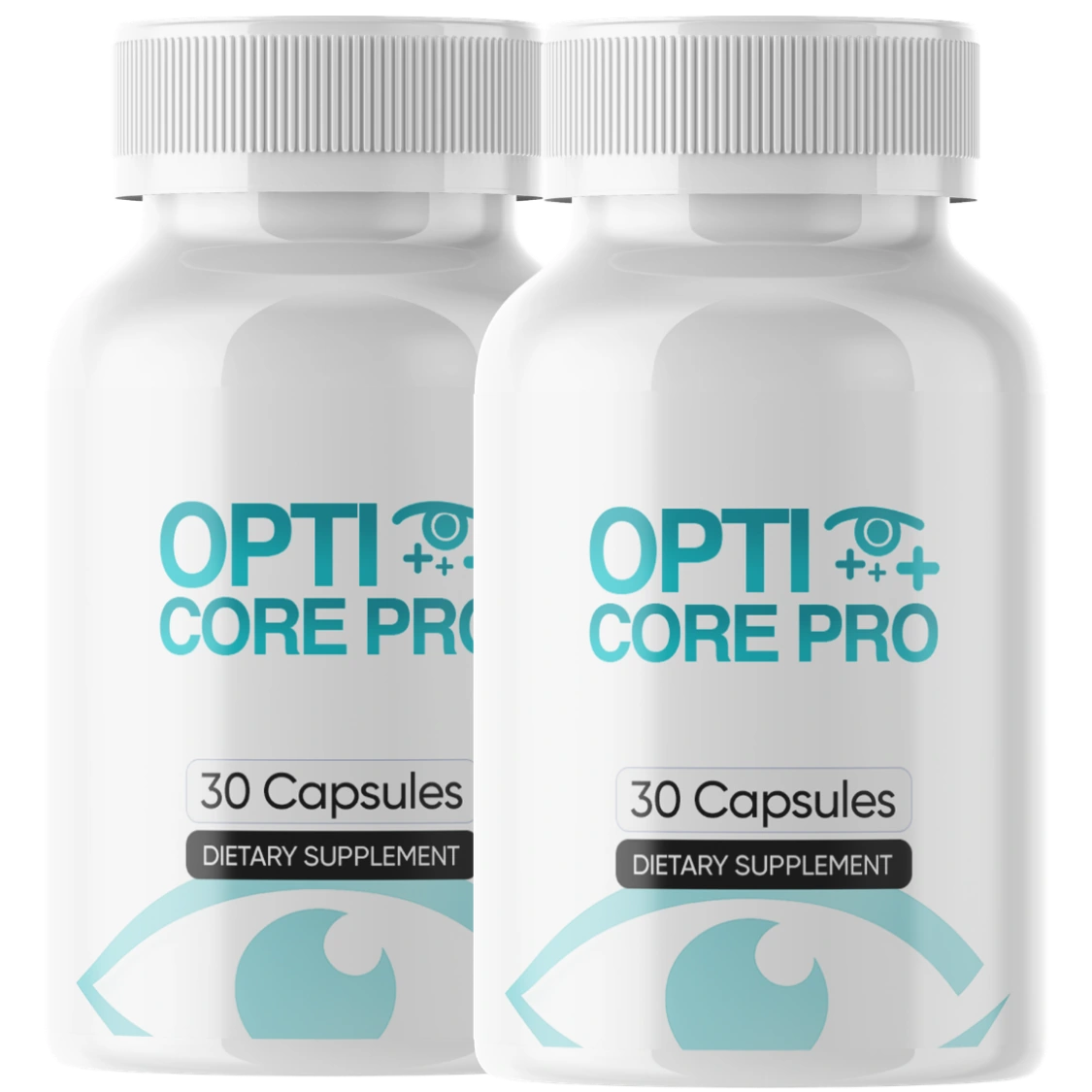
Do the division on the OptiCore Pro panel yourself
Every printed amount is on this website beside the amount its own trial used, including the four rows where the two are furthest apart.
Two bottles $158 · six bottles $294 · 60-day money-back guarantee
Order OptiCore Pro On The Official WebsiteOne capsule a day · 30 per bottle · lot OPT-26/OP-2761
Why a fraction is not a small version
This is the conceptual point the whole article exists for, and it is easy to state and easy to forget.
If a trial gives 500 mg and a capsule gives 60 mg, the capsule is not delivering twelve per cent of the benefit. Dose-response relationships in nutrition are rarely linear and are frequently threshold-shaped: below a certain intake nothing happens, above it an effect appears, and above that nothing further happens.
The honest position is that the smaller amount is a different intervention whose effects have to be argued on their own evidence. Sometimes that evidence is good. Correcting a deficiency at an ordinary Daily Value amount is well supported. It is simply not the same claim as the trial's.
Three ways the fallacy shows up
- A label naming the trial nutrients without the amounts, so a reader supplies the connection.
- Marketing copy citing a study for an ingredient at an amount the study did not use.
- A shopper assuming that more ingredients from the list means more of the effect, when amount decides it.
The copper corollary
Copper is in the AREDS formula for one reason and it is not an eye reason. Eighty milligrams of zinc oxide a day, sustained for years, competes with copper for absorption and depresses copper status. The trial added 2 mg of cupric oxide to prevent that.
This produces a useful rule for reading any label. If a formula carries high zinc and no copper, it has copied the trial carelessly. If it carries low zinc and no copper, its absence is correct, because there is nothing to offset.
It is also a rare case where an absence on a label is evidence of care rather than of cost-cutting, and it is worth knowing so that a reader does not count it as a failure.
What AREDS2 changed, and why
AREDS2 tested two additions to the original formula: lutein 10 mg with zeaxanthin 2 mg, and DHA 350 mg with EPA 650 mg. The omega-3 addition produced no further benefit at all.
The secondary analysis is what changed the product. It found lutein and zeaxanthin a better choice than beta-carotene, particularly in people with low dietary carotenoid intake, and the beta-carotene came out of the formula. The safety finding in smokers was the other half of that decision.
So the current benchmark formula is vitamin C 500 mg, vitamin E 400 IU, zinc 25 or 80 mg, copper 2 mg, lutein 10 mg and zeaxanthin 2 mg. Those six figures are what any label claiming the AREDS lineage should be measured against.
What a multivitamin amount is genuinely good for
Having spent an article on what these amounts are not, it is only fair to say what they are.
A row at fifty or a hundred per cent of a Daily Value is formulated to close a gap in somebody whose intake is short, every day, indefinitely, with no upper-limit concern. That is a genuinely useful thing and it is what the entire multivitamin category is for.
It is also the only claim a panel like this can support, which is why the most accurate description of a formula sharing three nutrients with AREDS at a tenth of the amounts is a competent daily multivitamin, sold with an eye framing.
Applying this to a label in two minutes
- Find the four shared nutrients on the panel: vitamin C, vitamin E, zinc, and vitamin A or beta-carotene.
- Convert the vitamin E into milligrams if the label uses international units.
- Divide each by 500, 268, 80 and 15 respectively.
- Look for lutein and zeaxanthin, and compare with 10 mg and 2 mg.
- Check whether copper is present, and whether the zinc amount makes it necessary.
If the ratios come out near one, the label is following the trial. If they come out near a tenth, it is a multivitamin, which may still be exactly what you want for entirely different reasons. Either answer is worth having before paying, and the whole exercise is the first three rows of the scorecard.
Every study named above measured a nutrient at an amount its own researchers chose. None of them tested OptiCore Pro, which has never been trialled as a finished formula. The comparison on this page is arithmetic between two published numbers and nothing more.
References
- Age-Related Eye Disease Study Research Group. A randomized, placebo-controlled, clinical trial of high-dose supplementation with vitamins C and E, beta carotene, and zinc for age-related macular degeneration and vision loss: AREDS report no. 8. Arch Ophthalmol. 2001;119(10):1417-36. PMID 11594942. https://pubmed.ncbi.nlm.nih.gov/11594942/
- Age-Related Eye Disease Study Research Group. A randomized, placebo-controlled, clinical trial of high-dose supplementation with vitamins C and E and beta carotene for age-related cataract and vision loss: AREDS report no. 9. Arch Ophthalmol. 2001;119(10):1439-52. PMID 11594943. https://pubmed.ncbi.nlm.nih.gov/11594943/
- Chew EY, Clemons TE, Agron E, et al. Long-term effects of vitamins C and E, beta-carotene, and zinc on age-related macular degeneration: AREDS report no. 35. Ophthalmology. 2013;120(8):1604-11.e4. PMID 23582353. https://pubmed.ncbi.nlm.nih.gov/23582353/
- Age-Related Eye Disease Study 2 Research Group. Lutein + zeaxanthin and omega-3 fatty acids for age-related macular degeneration: the Age-Related Eye Disease Study 2 (AREDS2) randomized clinical trial. JAMA. 2013;309(19):2005-15. PMID 23644932. https://pubmed.ncbi.nlm.nih.gov/23644932/
- Age-Related Eye Disease Study 2 (AREDS2) Research Group, Chew EY, Clemons TE, et al. Secondary analyses of the effects of lutein/zeaxanthin on age-related macular degeneration progression: AREDS2 report No. 3. JAMA Ophthalmol. 2014;132(2):142-9. PMID 24310343. https://pubmed.ncbi.nlm.nih.gov/24310343/
- Li SS, Wang HH, Zhang D. Efficacy of different nutrients in age-related macular degeneration: A systematic review and network meta-analysis. Semin Ophthalmol. 2022;37(4):515-523. PMID 34995151. https://pubmed.ncbi.nlm.nih.gov/34995151/